
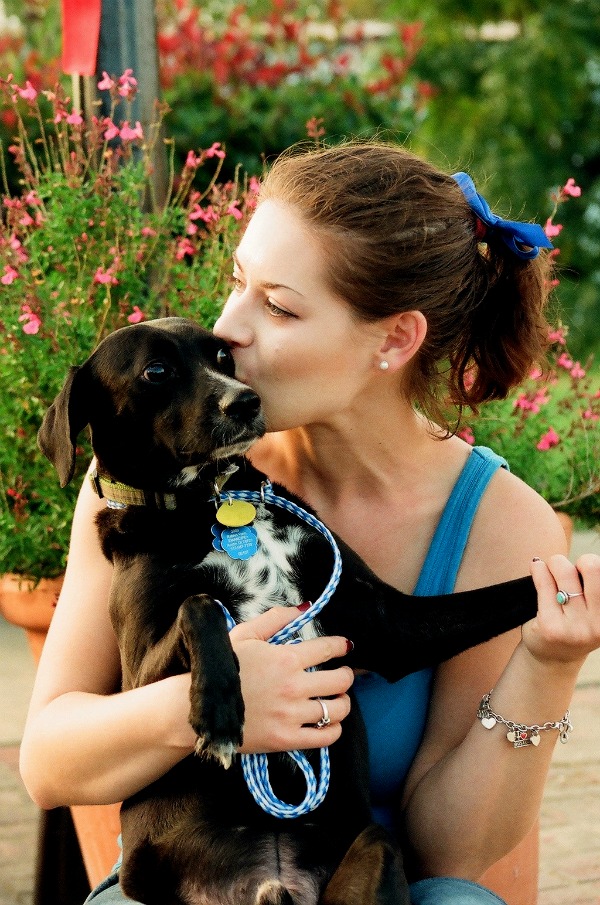
This is Jackson, my very first dog. I brought him home from the animal shelter because, well, he was a hot mess. He was so skinny his ribs were showing, he was throwing up and had diarrhea due to untreated intestinal worms, he was dirty, his teeth looked like those of a senior dog even though he was less than two years old, he flinched at every sound, and he was terrified of men. In fact, for the first several days, I had to physically carry him from place to place because he was often too afraid to even walk a few feet.
I have no clue what happened to Jackson before I brought him home. He was found roaming the streets. That’s all I know. I can only imagine the terrible things he experienced and I often wonder, if only people had treated him the way they would have wanted to be treated, he never would’ve been neglected, abused, or traumatized. To this day, nearly eight years later, he’s still extremely timid and skittish.
I recently watched a documentary on Netflix called Live and Let Live. It’s a thoughtful examination about the relationship between animals and humans, and it discusses the meaningful reasons why people choose to be vegan. It really made me think about this idea of the Golden Rule, “do unto others as you would have them do unto you,” which typically involves human to human interactions. But it’s important for people to understand that by not extending the same courtesy to animals and the environment, we’re not only hurting them, but ourselves. We must understand that everything is interconnected and if we want to do good, we must do good to all.
ANIMALS

My friend feeding the local deer, who are often victims of hunters and reckless drivers.
Since the existence of human beings, we have used animals for our own purposes. We suffer from speciesism, the idea that being a human means we automatically deserve greater moral rights than non-human animals. “Human supremacy” is another good term for it. So just because we are human beings means we don’t have to take any other species into consideration? With an attitude like that, no wonder the world is full of hate and killing and suffering.
“We have excluded animals from moral consideration,” as Peter Singer, Professor of Bioethics at Princeton, puts it. Just because we’re a certain species doesn’t mean we have “a special right to life.” The way we view animals says a lot about our society, and speciesism is the animal form of racism. If we view animals as second rate because they are different, we will find a way to let that same myth permeate our societies as well. We see it everyday. We see it all throughout history. Slavery, oppression, persecution, injustice… the list goes on and on.
Animals are not as different from us as we may think. They look different and they don’t speak our language, but we share many similar traits. Studies clearly show that animals experience pain, stress, and trauma, especially animals that are victims of factory farming. Cows, pigs, chickens, and other animals on factory farms can be so affected by the negative emotions they experience there, they incur abnormal behavioral changes. That means animals are not only aware of their surroundings and aware of their quality of life, but they react to a poor quality of life. They aren’t robots, they aren’t dumb – they care about their lives. Therefore, it’s established that animals are sentient creatures, and as Ethologist & Biologist Jonathan Balcombe states, “Sentience is the bedrock of ethics.” That means we must acknowledge that causing pain to animals is morally wrong.
Just because an animal cannot physically describe their desire to live, doesn’t mean they don’t have that desire or that they’re okay with being exploited. “[Animals] are not only alive, they are the subject of a life,” says Tom Regan, a Professor of Philosophy. Animals “retain their identity over time,” just like humans. They’re put on this Earth for a reason, like us. Is a human being’s purpose to be exploited, tortured, or killed? No. I think most people believe our purpose is to enjoy life, help one another, and experience love. We’re all in this together, and that includes all species, not just humans. “You don’t exist for me, and I don’t exist for you,” Regan reminds us. Because our use of animals has become second nature, we don’t stop to remind ourselves that animals don’t want to be hunted, they don’t want to be worn as clothing, they don’t want to perform tricks at the circus, or be contained behind bars at zoos, they don’t want to be used in experiments, or tortured, abused, eaten, and killed. Saying an animal has no desire to live is like saying “beings that have eyes have no interest in seeing, ” says Gary Francione, a Distinguished Professor of Law.
One of the most poignant stories in Live and Let Live was a German farmer remembering a girl that came to train at his farm. When she found out one of the cows was to be slaughtered the next day, she kept asking “Why?” The farmer explained that’s what happens on a farm. The girl went and got her flute and played it all night for the cow. She continued playing it on the ride to the butcher, all the way until he came in with the bolt gun. What a simple, yet deeply compassionate act to show appreciation for the life of another creature. Even though the girl couldn’t change the situation, she put herself in the cow’s place and treated her the way she would want to be treated in that situation, with kindness and love.
ENVIRONMENT

The nearly dried up lake at Sal del Rey in South Texas. It’s been around for hundreds of years, but won’t last much longer due to climate change.
When it comes to the Golden Rule, we may not think to include the environment, but we only have one Earth and we should treat it with respect. What’s interesting to me is how our treatment of animals affects the environment, which directly affects us, and we’ve essentially created our own vicious cycle of self-destruction.
Two thirds of the Earth’s land mass is used for animal pastures and livestock. Two thirds! And yet for every 7 calories of plant food that an animal consumes, they only produce 1 calorie. Using meat as the “middle man” for human protein is a massive waste of plants, animals, resources, and land. We justify eating animals because they give us nutrition and protein, but we can get more bang for our buck by only farming plants, which are far more nutritious and cause less waste. It’s more efficient to eat the plants directly, rather than eating animals to get the protein they got from eating plants. See what I’m getting at??
We’re destroying natural vegetation to pasture animals for meat. If we let the natural vegetation grow back, it “would absorb CO2 from the atmosphere like a sponge,” says Geophysicist & Food Scientist Kurt Schmidinger. “We cannot sustain this wasteful system,” all in the name of creating a small output of meat for humans to consume. This “loss of biodiversity” for livestock production/meat is causing climate change, and with this rapid change it becomes increasingly difficult to farm due to the erratic climate variables. Our obsession with producing meat is not only destroying the Earth, but it may destroy it to the point where meat production will no longer be viable because of the environmental damage it has caused. Quite the Catch-22, isn’t it? The good news is, we can reverse quite a bit of these negative effects by halting meat production.
PEOPLE

A better representation of how our relationship with animals should be. On equal ground.
Our master-slave relationship with animals can directly affect our quality of life as humans. For instance, workers in slaughterhouses are victims and often become victimizers as well. Many of these workers are undocumented immigrants or non-English speaking immigrants that are unable to speak up for their rights, just like the animals they are slaughtering. These workers suffer from high rates of addiction and PTSD and because of the nature of their job, they become desensitized to violence as a coping mechanism. In fact, it can cause many of these workers to take out their anger in the form of domestic abuse. This is important because not only does this kind of work affect the workers and their ability to function in society, but it affects their families and the people they interact with. Slaughterhouse and factory farm workers are also well known to abuse the animals they work with, beating and torturing them. I cannot even imagine the psychological effect it would have on a person to work in what are essentially death camps for animals. If we turned these factory farms and slaughterhouses into land for farming fruits and vegetables, the suffering would end on both sides. Not only that, but we’d create enough food to feed all the starving people in the world because as stated above, it’s much more efficient to farm crops than livestock.

When I taught English to kids in Beijing, I got to do cool projects, like teach them how to make vegan desserts!
These are just some of the consequences that occur when the Golden Rule only applies to humans. And humans are flawed. Nobody is perfect. Not even vegans. But being vegan is not about being perfect or better than anybody else, but rather the belief that we are all equal. Veganism is the idea of actively working to be the most aware, compassionate, best version of ourselves that we can be. To me, that fully embodies the idea of the Golden Rule.
However, if someone is not vegan, it doesn’t mean they don’t care about others. Although we make ethical choices with every bite we take, non-vegans can show compassion in other ways as well. Being educated on issues revolving around animals, the environment, and other people is first and foremost because choices stem from beliefs and “without awareness there is no free choice,” says social psychologist Melanie Joy. From there, it’s easy to find simple ways to better the world and those that reside in it. Recycling, bringing sustainable bags to the grocery store, and picking up litter are ways to help the environment. Volunteering at an animal shelter or donating items, not giving money to organizations that exploit animals (zoos, circuses, etc), and knowing what rescue groups are in your community should you come across an animal that needs help are perfect ways to show compassion for our furry friends. And small actions such as smiling at strangers, saying thank you, and asking someone how their day was can have a huge impact on a person, causing a ripple effect to take place.
It’s all about awareness and putting yourself in someone else’s place, whether they are human or animal or Earth. It can only do good. Live and Let Live brings to light how deeply entrenched and interconnected our relationship with animals really is. Once people realize that respect goes many ways and that no one is superior to anyone else, then real change can take place and true peace can permeate. It’s never too late.
Jillian 💙
Beautifully written. Thank you for being a person of love and compassionate. I thank you and so do the animals <3
Thank you so much Nicole!! I really appreciate that 🙂